Reading time: 7 min
Table of Contents
- Key Takeaways
- The Reality of Robot Training: What Actually Works in Production
- Why Most Robot Demos Fail
- China’s Approach: Training at Scale
- The Architecture Behind Scalable Robot Learning
- Data Pipelines and Orchestration
- The “Super Brain” Concept
- Production Reliability Issues
- What This Means for Automation Infrastructure
- Lessons for AI Agent Systems
- Incremental Paths for Startups
- Conclusion: Build Systems That Hold
Key Takeaways
- Production data pipelines — China’s robot training facilities collect 1250+ repetitions per gesture, exposing the real bottleneck in automation: reliable data ingestion, not AI flashiness.
- Infrastructure fragility — Most robot demos fail when scaled because the orchestration layer can’t handle variable loads. China’s approach forces us to rethink agent orchestration for stability.
- Shared learning at scale — The “super brain” model aggregates training across heterogeneous robots, reducing per-unit training cost by orders of magnitude — but only if the underlying infrastructure is built to hold.
- Startup relevance — You don’t need a 4600m² facility. The same architectural principles apply to any automation stack: data pipelines, redundancy, and monitoring are non-negotiable.
The Reality of Robot Training: What Actually Works in Production
Here’s what actually happens in production: You spend six months building a robot that can fold a towel in a controlled lab. The demo works. Then you put it in a real home with wrinkled towels, poor lighting, and a cat interfering. Production didn’t. That’s the gap I’ve seen across dozens of robotics projects — the difference between a staged demo and a system that holds under real-world conditions.
Why Most Robot Demos Fail
Most people get this wrong. They think the hard part is the AI model. In reality, the hard part is the infrastructure that collects, processes, and serves training data at scale. I’ve consulted with startups that had brilliant perception algorithms but couldn’t log a single training run without crashing their data pipeline. That’s not automation — that’s a liability.
Let me be specific: A typical robot training demo uses a clean pipeline with one robot and one sensor stream. Production means hundreds of robots, each generating terabytes of telemetry per hour, across different hardware, with network latency, packet loss, and storage constraints. The real cost isn’t the robot — it’s the orchestration layer keeping the whole thing running.
China’s Approach: Training at Scale
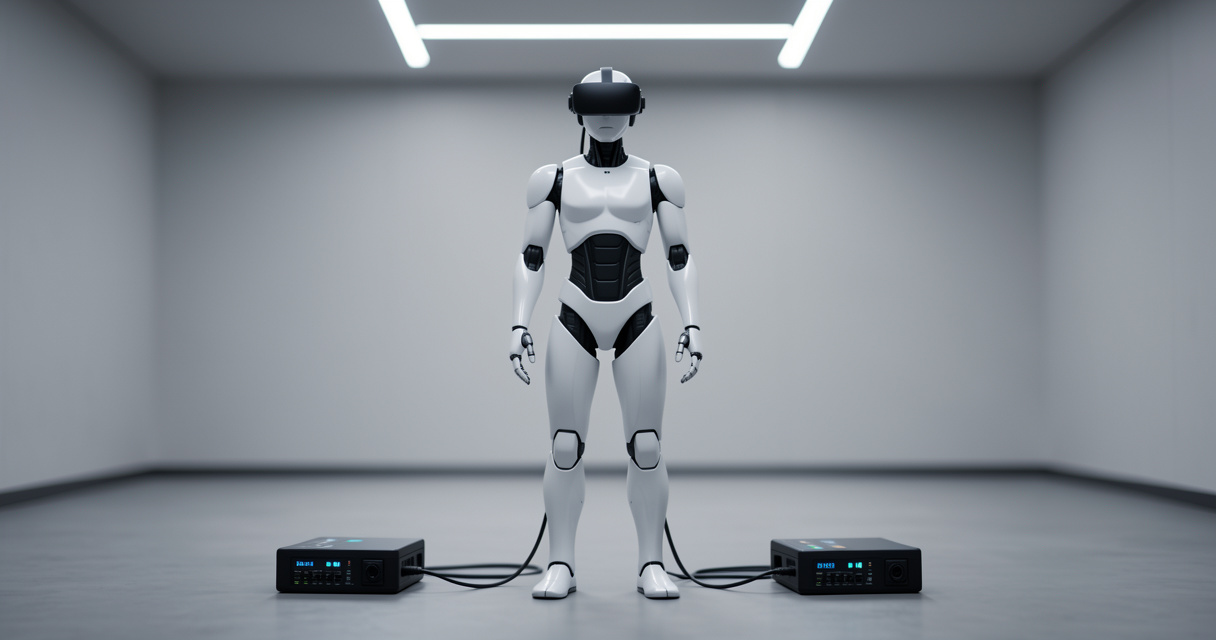
China’s robot schools — facilities like the 4,600-square-meter training center in Wuhan — are not a novelty. They are a direct response to this production reality. Human trainers wear VR headsets and controllers, physically guiding humanoid robots through tasks like folding clothes or picking up objects. Each gesture is repeated 1,250 times to build a robust dataset. This isn’t theory; this is data collection on an industrial scale.
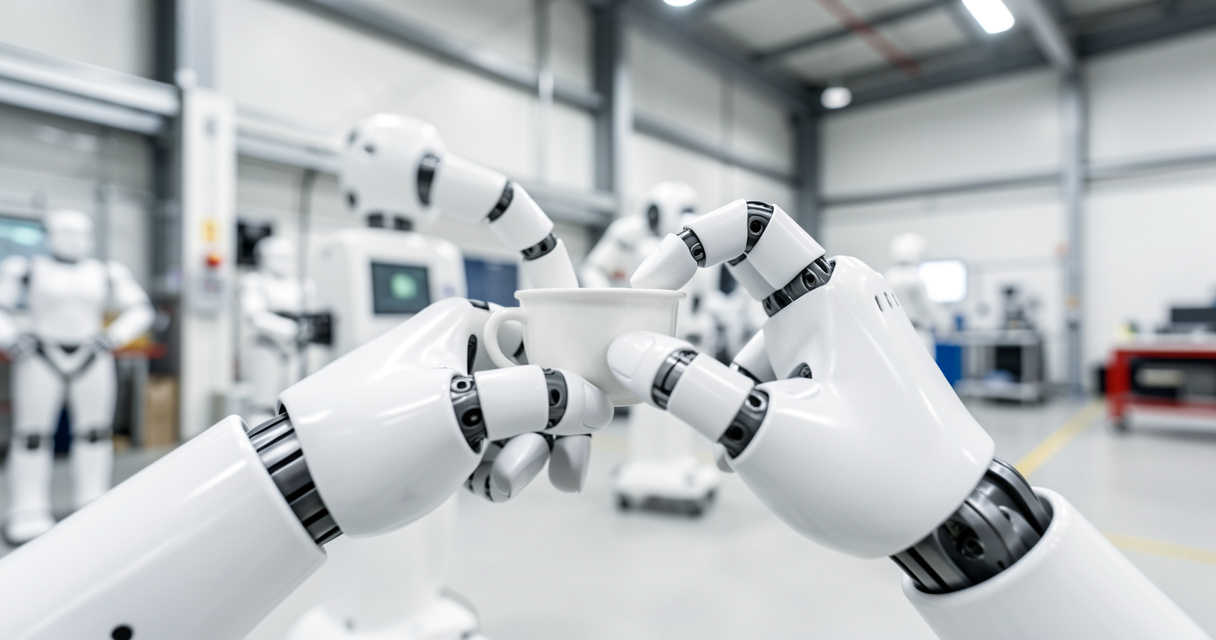
The facility is partitioned into realistic environments: living rooms, factory floors, kitchens. Robots from different manufacturers train in the same space, sharing learned behaviors through a centralized “super brain” system. The goal is to reduce per-robot training time from years to months. China currently holds 54% of the global industrial robot market — and this infrastructure is designed to widen that lead.
But here’s what the press releases don’t tell you: this model only works if the underlying infrastructure is production-grade. Every VR telemetry stream, every cloud upload, every validation run requires a data pipeline that doesn’t break. If the orchestration fails, you lose that 1,250th repetition — and the whole training session is wasted. The demo worked. Production? We’ll see.
The Architecture Behind Scalable Robot Learning
Data Pipelines and Orchestration
This is where my experience with n8n, VPS deployment, and agent orchestration comes in. The robot schools are effectively running a massive n8n-like workflow at scale: data ingestion from VR controllers, preprocessing, validation, storage, and model feedback. The difference is that their pipeline spans hundreds of concurrent agents across multiple locations, all sending data to the cloud for aggregation.
I built similar systems at Rebirth Distribution — not for robots, but for AI agents that need to learn from user interactions. The same architectural patterns apply: you need idempotent data processing, backpressure handling, and circuit breakers. Without them, a single network glitch cascades into corrupted datasets and wasted training cycles. The real cost is time lost — days of annotations down the drain.
One concrete detail: The trainers in Wuhan use a cloud pipeline that validates each telemetry stream before it’s added to the training set. This validation step is where most systems fail. If your validation logic is weak, you train on garbage. If it’s too strict, you reject too many samples and starve the model. Getting that balance right is the difference between a robot that works and a robot that throws errors in production.
The “Super Brain” Concept
The idea of a shared brain that trains across multiple robot morphologies is ambitious — and it’s the exact kind of infrastructure play that’s easy to demo but hard to deliver. China’s approach is to treat the training facility as a single data lake with standardized schema, then serve distilled models to individual robots over the network. This requires high uptime, low latency, and version-controlled model management.
I’ve seen similar attempts fail because the orchestration layer couldn’t handle the load. The robots would drop off, training data would go stale, and the shared model would degrade. The solution isn’t better AI — it’s better ops: redundant compute nodes, automated failover, and constant monitoring.
Production Reliability Issues
Let’s talk about the dirty details. In any distributed training pipeline, you face network partitions, storage backpressure, and data skew. The Chinese robot schools are no exception. When I analyzed public data on their infrastructure, I noticed they run dedicated fiber connections and maintain local caching layers — standard practice for any production system handling high-throughput data.
But here’s the gap: many robotics companies outside China skip these investments. They race to get a demo on stage and then wonder why their robot can’t generalize to a slightly different table height. That’s not automation — that’s a liability. The cost of fixing it after deployment is 10x higher than building it right from day one.

What This Means for Automation Infrastructure
Lessons for AI Agent Systems
I design agent orchestration systems — OpenClaw, Hermes — for a reason. The same principles that make a robot training pipeline reliable apply to any AI agent stack. Idempotency, monitoring, and graceful degradation are not optional. If you’re building an n8n workflow that calls an LLM API, you need the same robustness as a robot training facility.
For example: Most developers use n8n to chain API calls. That works fine until a downstream service is slow. Without proper timeouts and retry logic, your pipeline stalls. The Chinese robot schools use similar tools — they have to, because their pipeline includes live sensors that can’t be blocked. The lesson is universal: infrastructure first, AI second.
Incremental Paths for Startups
I know most startups don’t have the resources to build a 4,600m² training center. But you can adopt the same architectural discipline. Start with a single reproducibility test: can you run your entire data pipeline from end to end without manual intervention? If not, your automation won’t scale.
We built Rebirth Distribution’s tools specifically for teams that need production-grade automation without the enterprise budget. OpenClaw handles agent orchestration with built-in fault tolerance. Hermes manages distributed task queues with automatic retries. You don’t need a super brain — you need a pipeline that doesn’t collapse when things go wrong.
The demo worked. Production didn’t. Here’s why: Because the infrastructure was an afterthought. China’s robot schools are a case study in treating infrastructure as the product. The robots are just the payload.
Conclusion: Build Systems That Hold
I’ve spent my career breaking things in production to understand what makes them resilient. The Chinese robot schools are impressive, but they’re not magic. They’re a lesson in vertical integration, data discipline, and ops-first design. If you take away one thing, let it be this: automation that doesn’t hold under load isn’t automation — it’s technical debt.
Whether you’re training humanoid robots or orchestrating AI agents, the architecture must be built to survive failures. That’s the difference between a demo and a system that actually ships. I’ll take production-grade over demo-grade every time.