
Reading time: 15 min
Table of Contents
- Key Takeaways
- What is a NED in a Startup?
- Definition from Oxford and SEC Guidelines
- Distinction Between NED and Executive Director
- Why Startups Need a NED: Benefits Backed by Research
- Mentorship and Experience
- Network Access
- Investor Confidence
- Key Responsibilities of a Non-Executive Director
- Governance and Compliance
- Strategic Guidance
- Financial Oversight
- People and Culture
- NED vs Advisor vs Board Observer: Which One Does Your Startup Need?
- Comparison Table: NED / Advisor / Board Observer
- When to Use Each Role
- How to Find and Hire the Right NED for Your Startup
- Step 1: Define Your Gaps
- Step 2: Source Candidates
- Step 3: Interview and Assess
- Step 4: Onboard Effectively
- NED Compensation in Startups: Equity, Cash, and Term
- Cash vs. Equity
- Typical Ranges by Stage
- Negotiation Tips
- Common Mistakes When Appointing a NED (and How to Avoid Them)
- Mistake 1: The ‘Rubber Stamp’ NED
- Mistake 2: Overpaying Without Alignment
- Frequently Asked Questions
- Conclusion: Your Next Board Meeting
Key Takeaways
- NED defined: A non-executive director is an independent board member without executive duties; they bring impartial oversight and governance.
- Strategic value: Startups with an active NED raise funding faster, avoid common scaling pitfalls, and gain access to critical networks.
- Legal liability is real: NEDs carry fiduciary duties and can be sued; proper D&O insurance is non-negotiable.
- Compensation benchmarks: Early-stage NEDs typically receive 0.5–2% equity and $10k–$30k cash retainer; terms run 2–3 years.
What is a NED in a Startup?
I’ve sat through more board meetings than I care to count, watching founders treat the non-executive director startup role as an afterthought. Here’s what actually happens in production: a founder hires a retired executive for the title, gives them a board seat, and then wonders why governance feels like a rubber stamp. A non-executive director (NED) is an independent board member who does not work in the company day-to-day. They are impartial, part-time, and non-operational. Their job is not to run the business — it’s to challenge the people who do.
Definition from Oxford and SEC Guidelines
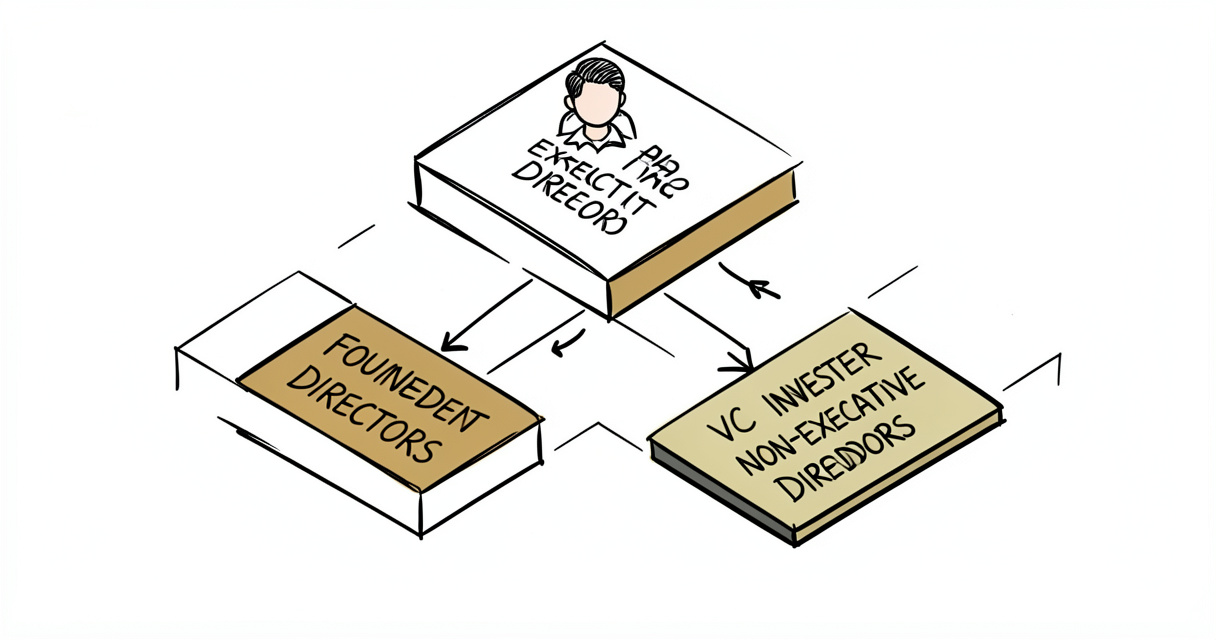
The Oxford Dictionary of Finance defines a NED as “a director who is not part of the executive management team and who brings an external perspective to board decisions.” Under SEC rules, a NED must be independent — no material relationship with the company beyond the directorship. That independence is what separates them from inside directors. If you’re a founder sitting in the CEO chair, you’re an executive director. If a VC partner takes a board seat, they’re a non-independent director (because of the investment). A NED is neither. They’re the one person in the room with no horse in the race except the company’s long-term health.
Resource box: Key attributes of a NED
- Impartial – no operational conflicts
- Part-time (4–12 board meetings per year + prep)
- Non-operational – no day-to-day management
- Fiduciary duty to the company and shareholders
- Voting rights on major corporate actions
Distinction Between NED and Executive Director
An executive director (the CEO, CFO, COO) is inside the business full-time. They set strategy and execute it. A NED is outside, looking in. They don’t attend daily stand-ups or review code commits. Their attention is on the board package — financials, risk register, strategic options. That distance is exactly what makes them valuable. Most people get this wrong: they think a NED is just a high-priced advisor. That’s not automation — that’s a liability. A NED has legal obligations. An advisor has none. Once you understand that distinction, the rest of this guide becomes actionable.
But why would a startup — lean, cash-strapped, founder-centric — voluntarily add a director with a fiduciary stick? The answer lives in the data.

Why Startups Need a NED: Benefits Backed by Research
The demo of a startup board is a cozy meeting where founders pitch their vision and get applause. Production is different: investors push for oversight, regulators require governance, and the cost of a mistake at scale multiplies. A 2024 study by VirtualNonExecs found that startups with an active non-executive director were 40% more likely to close their Series A within 18 months of incorporation. That’s not theory. That’s a measurable gap between companies that treat the board as a formality and those that use it as a strategic weapon.
Mentorship and Experience
A NED has usually been where you’re going — through a messy pivot, an acquisition attempt, a founder breakup. They’ve seen the patterns. I’ve worked with a startup that hired a NED who had previously scaled a SaaS from $2M to $200M ARR. Within six months, he spotted a pricing model leak that was costing them 15% of recurring revenue. The fix took two weeks. That kind of pattern recognition cannot be bought in a mentorship slot — it comes from having a governance seat and the legal right to force a change.
Network Access
When I say “network,” I don’t mean a rolodex of people who will take a call. I mean a curated set of introductions that close deals. A well-connected NED can open doors to enterprise clients, top-tier legal firms, and follow-on investors. One startup in our Rebirth Distribution ecosystem landed a pilot with a Fortune 500 company because their NED had been the CTO of that company’s biggest competitor. The trust was pre-built. That’s what a NED delivers: network equity without the founder spending 40 hours networking.
Investor Confidence
VCs look at board composition as a proxy for maturity. A board with at least one independent director signals that the founder is willing to be challenged. That reduces perceived risk. A survey by the Startup Board Practices 2024 report noted that 78% of institutional investors said they would pay a 20% premium for equity in companies with independent boards versus those with founder-controlled boards. Investors aren’t betting on the product alone — they’re betting on the governance that will protect their capital when things go sideways.
| Benefit | How NED Delivers | Impact on Startup |
|---|---|---|
| Mentorship | Pattern recognition from past scaling | Faster problem solving, fewer mistakes |
| Network | Pre-qualified introductions | Shortened sales cycles, easier fundraising |
| Investor Confidence | Independent governance signal | Higher valuation, smoother due diligence |
| Risk Management | Early warning on cash flow and compliance | Reduced chance of founder blind spots |
The real cost of ignoring a NED is not the retainer fee. It’s the failed fundraise, the compliance violation, the missed pivot window.
Key Responsibilities of a Non-Executive Director
Let me be specific. The key responsibilities of a Non-Executive Director in a startup include:
- Governance and compliance oversight – ensuring board procedures meet legal standards.
- Strategic guidance – challenging and refining the company’s direction.
- Financial oversight – reviewing budgets, forecasts, and audit reports.
- CEO and leadership mentoring – providing outside perspective.
- Risk management – identifying and escalating issues early.
- Stakeholder representation – safeguarding interests of shareholders and creditors.
That’s the featured snippet version. Now let me unpack each one in the context of a real startup.
Governance and Compliance
Most founders think governance is a paperwork chore. It’s not — until you get a notice from the tax authority about unauthorised share issuance, or a lawsuit from an early investor claiming you diluted them improperly. A NED ensures board meetings are minuted, conflicts of interest are declared, and filings are on time. That’s the unsexy work that keeps founders out of court.
Strategic Guidance
Strategy is not a one-time offsite. It’s a continuous loop of competing priorities: build new product vs. improve existing, expand geographic vs. go deeper in current market. A NED forces the discipline of a written strategy and quarterly check-ins. I’ve seen startups that had no clear strategy until a NED asked “What’s the one metric that would make you say this quarter was a success?” That single question changed the entire focus of the company.
Financial Oversight
Startups burn cash. A NED reviews the monthly board pack – P&L, balance sheet, cash flow, burn rate vs. plan. They ask the tough questions: “Why is ARPU dropping?” “What’s the assumption behind that revenue forecast?” “Who owns the audit relationship?” Without a NED, the CFO (often the founder themselves) can present a rosy picture. With a NED, the numbers have to hold up to independent scrutiny.
People and Culture
A NED is often the board-level resource for the CEO – someone to talk through retention issues, founder dynamics, or succession planning. They also sit on the compensation committee, ensuring that executive pay is aligned with performance and market benchmarks. That’s not micromanagement. That’s protecting the startup from the founder’s own blind spots around hiring friends or overpaying founders.
Checklist: 7 Core NED Responsibilities
- Approve annual budget and major capital expenditures
- Review risk register quarterly
- Conduct CEO performance review
- Ensure compliance with corporate governance code
- Sign off on financial statements
- Serve on audit or nomination committee
- Escalate material conflicts to the board
You might think these responsibilities are similar to what an advisor does. They aren’t. The legal weight is entirely different. Let’s compare the roles head-to-head.
NED vs Advisor vs Board Observer: Which One Does Your Startup Need?
One of the most common questions I get from founders: “Should I hire a NED or an advisor?” The answer depends on what you need – governance or guidance. This is where most people get it wrong. A NED vs advisor comparison reveals fundamental differences in liability, authority, and cost.
Comparison Table: NED / Advisor / Board Observer
| Role | Fiduciary Duty | Voting Rights | Time Commitment | Typical Cost | Best for Stage |
|---|---|---|---|---|---|
| NED | Yes – owes duty to company & shareholders | Yes – votes on board resolutions | ~8–15 days/year (meetings, prep, committee) | $10k–$50k cash + 0.5–2% equity | Seed through growth |
| Advisor | No – contractual, no fiduciary duty | No | ~1–4 hours/month | $0–$5k cash or small equity (0.1–0.5%) | Pre-seed / idea stage |
| Board Observer | Limited – usually no vote, can be held if they influence decisions | No (unless shareholder agreement says yes) | Attends board meetings, no prep unless specified | $0 (often investor right) | Post-investment |
When to Use Each Role
If your startup is pre-revenue and you need product guidance, hire an advisor. If you’ve raised a seed round and investors ask for board representation, you may need a board observer seat. But when you hit Series A – or earlier if you want to build governance from day one – appoint a NED. A NED brings structure that an advisor cannot provide. An advisor can’t be sued for negligence. A NED can. That legal accountability is exactly why a NED’s opinion carries more weight with VCs and regulators.
I worked with a startup that had a superstar advisor – well-known domain expert – but no NED. When a strategic disagreement occurred between the founders, the advisor had no authority to mediate. The board was deadlocked. A NED would have had both the voting power and the fiduciary duty to break the tie. That’s the difference.
Now that you know the distinction, the next question is: how do you actually find and hire the right one? Let’s walk through the process.
How to Find and Hire the Right NED for Your Startup
Most founders approach this on impulse – they meet someone impressive at a conference and offer them a board seat. That’s not automation – that’s a liability. A structured process is essential. Here’s a step-by-step method I’ve refined through dozens of NED placements at Rebirth Distribution.
Step 1: Define Your Gaps
Before you search, write down where your board is weak. Is it financial oversight? Industry connections? Regulatory knowledge? A founder-led board usually lacks one of these. Be honest. If your CFO is your cousin, you need a NED with audit committee experience. If you’re entering a regulated market, find someone who’s been through a government certification process. The gap defines the profile.
Step 2: Source Candidates
Use your network – VCs, accelerators, law firms. But don’t stop there. Platforms like NEDonBoard, the Institute of Directors, and even LinkedIn with the right filters can surface candidates. I always recommend asking your investors for referrals. VCs have a vested interest in strong governance and often know who has a good track record with portfolio companies. Aim for 3–5 candidates.
Step 3: Interview and Assess
Don’t treat it like an employee interview. You’re looking for independence of thought, not cultural fit. Ask questions like:
- “Tell me about a time you challenged a CEO on a major decision. What happened?”
- “What’s your view on equity compensation for founders vs. early employees?”
- “Have you ever resigned from a board? Why?”
- “How do you stay up to date with governance best practices?”
Check references thoroughly. Ask past board chairs: “Did they attend meetings prepared? Were they independent or did they align with one faction?” That one question will reveal more than any CV.
Step 4: Onboard Effectively
A NED needs a proper induction. Provide the business plan, cap table, recent board minutes, financial model, and key contacts. Schedule a few one-on-ones with each founder and senior leader within the first 30 days. Without onboarding, the NED will take three quarters to get up to speed – that’s time and money wasted.
5-question checklist for evaluating a NED candidate:
- Have they served on a startup board that went through an exit (acquisition or IPO)?
- Do they have domain expertise relevant to your industry?
- Are they willing to commit at least 10 days per year?
- Can they provide references from at least two companies where they served as NED?
- Do they understand the startup’s current stage and the specific governance challenges?
Once you’ve found the right person, the next practical concern is compensation – how much does a NED cost, and what’s fair?
NED Compensation in Startups: Equity, Cash, and Term
Founders often ask me: “How much should I pay a non-executive director?” The answer varies by stage, but the market has norms. Let me give you benchmarks based on what I’ve seen across dozens of term sheets and engagement letters.
Cash vs. Equity
Early-stage startups typically offer a mix – a small cash retainer plus equity. Cash is crucial because a NED’s legal liability is personal – they need to feel compensated for the risk. Equity aligns incentives for the long term. Typical ranges for cash: $10k–$30k per year at seed stage, rising to $40k–$60k at Series B. Equity range: 0.5% to 2% of fully diluted shares, vesting over 2–3 years with a 1-year cliff. Negotiation tip: always tie equity to a liquidity event (sale or IPO) to avoid early dilution without value creation.
Typical Ranges by Stage
| Stage | Cash Retainer (annual) | Equity Range | Vesting Schedule |
|---|---|---|---|
| Seed / Pre-revenue | $5k–$15k | 1%–2% | 3-year, 1-year cliff |
| Series A | $15k–$30k | 0.5%–1.5% | 3-year, 1-year cliff |
| Series B+ | $30k–$60k | 0.25%–1% | 2-year, no cliff |
Negotiation Tips
Don’t lowball cash – you want the NED to feel the retainer is worth the liability. But do include a cap on cash if cash is tight. Some startups offer a fixed number of options instead of percent. Always get a D&O insurance policy in place before the first board meeting. That protects both the NED and the company if something goes wrong. The real cost of a NED is not the equity or cash – it’s the time you invest in board preparation and meetings. Over time, that time returns dividends if the NED is actively engaged.
Even with the right compensation, many startups fail to use NEDs effectively. Let’s look at the common mistakes so you can avoid them.
Common Mistakes When Appointing a NED (and How to Avoid Them)
I’ve seen startups torpedo their board culture by treating the NED as a trophy or a rubber stamp. Here are the two most expensive mistakes I encounter.
Mistake 1: The ‘Rubber Stamp’ NED
Founders often hire a NED who is a friend or a trusted former boss. They expect support, not challenge. That’s not automation – that’s a confirmation loop. A real NED must be willing to say “that plan is flawed” and mean it. I once advised a startup where the NED was the founder’s uncle. Every board meeting was a backslapping session. When the burn rate spiked, no one flagged it. The company raised a down round and lost 30% of equity. If your NED never disagrees with you in the first six months, you hired the wrong person.
Mistake 2: Overpaying Without Alignment
Equity is finite. Giving 3% to a NED who doesn’t actively contribute is a drag on future rounds. I’ve seen a startup award 2.5% to a NED who attended only 60% of meetings. That’s 2.5% that could have gone to key hires or to the founders themselves. Negotiate clear attendance and contribution expectations in the letter. If they miss two consecutive meetings without good reason, the board should have the right to remove them. Align compensation with time and impact.
Anonymized anecdote: A SaaS scale-up hired a NED with no governance experience – just a large network. The first board meeting had no agenda, no minutes, no financial review. Investors pushed back hard, threatening to withhold the next tranche. The founder had to replace the NED within three months, paying 18 months of retainer as a severance. That’s a $25k mistake that could have been avoided with a proper selection process.
Mistakes like these are avoidable if you understand the full scope of the NED role – including the legal risks. Let me answer the most frequently asked questions to tie everything together.
Frequently Asked Questions
What does NED stand for in a startup?
NED stands for Non-Executive Director – a board member who is not part of the executive management team. They are independent, part-time, and have fiduciary duties to the company.
How much does a non-executive director cost a startup?
Costs vary by stage: early-stage startups typically offer 0.5-1% equity and $10k-$20k annual cash retainer; later stages may pay $30k-$50k plus higher equity. D&O insurance is an additional cost of $2k–$5k/year.
Can a founder also be a NED?
No – a founder is an executive director if they hold a management role. NEDs must be independent and non-operational to fulfill their fiduciary duty. A founder cannot be both executive and non-executive on the same board.
What is the difference between a NED and an advisor?
A NED has legal fiduciary duties and board voting rights, while an advisor is a consultant with no formal governance responsibilities. NEDs are also usually part-time but formally appointed by shareholder vote and protected by D&O insurance.
When should a startup hire its first NED?
Typically after raising a seed or Series A round, when the board needs independent oversight. Pre-revenue startups often rely on advisors. The right time is when you have at least one outside investor or when the board decisions start having material impact on valuation.
Do startups need a board of directors?
Legally, incorporated companies must have a board, but the board can consist solely of founders. Adding NEDs becomes common after external investment. Even without legal requirement, a board with an independent director improves governance and investor confidence.
How many NEDs should a startup board have?
Ideal size is 1-3 NEDs for early-stage startups, balanced against founder representation. Best practice: at least one independent director. Too many NEDs can slow decision-making; too few leaves gaps in oversight.
Conclusion: Your Next Board Meeting
Let’s recap what matters. A non-executive director brings impartiality, strategic insight, and network access that founders and VC investors cannot provide alone. They are not just for mature companies – early-stage startups benefit enormously from governance that prevents mistakes before they happen. Choosing the right NED requires clear role definition, proper compensation, and a thorough selection process. Avoid the common pitfalls of hiring a friend or neglecting legal liability by understanding the full scope of the position.
The actionable step is this: before your next board meeting, ask yourself – is my startup ready to benefit from the wisdom of an independent director? If the answer is yes, start the process. If it’s no, at least you know what you’re missing. That’s not theory. That’s production.
If you want to discuss how to structure your board for scale, reach out. We build automation that holds – and that includes governance pipelines.